
GOALPOLES OPINION
The beautiful game has always possessed a unique ability to rise above geopolitical boundaries, uniting the globe through a shared language of athleticism, passion, and meritocracy. Yet, as the expanded 48-team FIFA World Cup 2026 kicks off, that foundational spirit is being systematically suffocated. Under its current leadership, FIFA is exhibiting an unprecedented level of institutional failure, spanning from flawed on-field sporting decisions to disastrous off-field administrative governance.
Instead of a celebration of global football, the buildup to this tournament has felt more like an exercise in logistical survival. For those watching closely at GoalPoles, the cracks in Zurich’s grand facade are no longer possible to ignore. FIFA’s operational framework is collapsing under the weight of its own administrative negligence, and nothing illustrates this disgraceful handling of the sport’s integrity quite like the treatment of Somali referee Omar Artan.
The Disgraceful Handling of Omar Artan
Omar Abdulkadir Artan’s journey to the World Cup was supposed to be a historic milestone for East African football. Named Africa’s top male referee of 2025 by the Confederation of African Football (CAF), Artan earned his place among the elite group of officials selected for the tournament through years of flawless performances on the continent's biggest stages, including the Africa Cup of Nations and the CAF Champions League final. He was set to become the first-ever Somali referee to officiate at a men’s World Cup—a powerful symbol of hope and merit-based achievement for a new generation of Somali youth.
Instead, that dream was subjected to an 11-hour interrogation nightmare at Miami International Airport. Despite possessing a valid, pre-approved travel visa issued by authorities just a week prior, Artan was stopped by U.S. Customs and Border Protection (CBP), detained in a holding cell, and subsequently deported back to Istanbul due to vague "vetting concerns" tied to sweeping geopolitical travel restrictions.
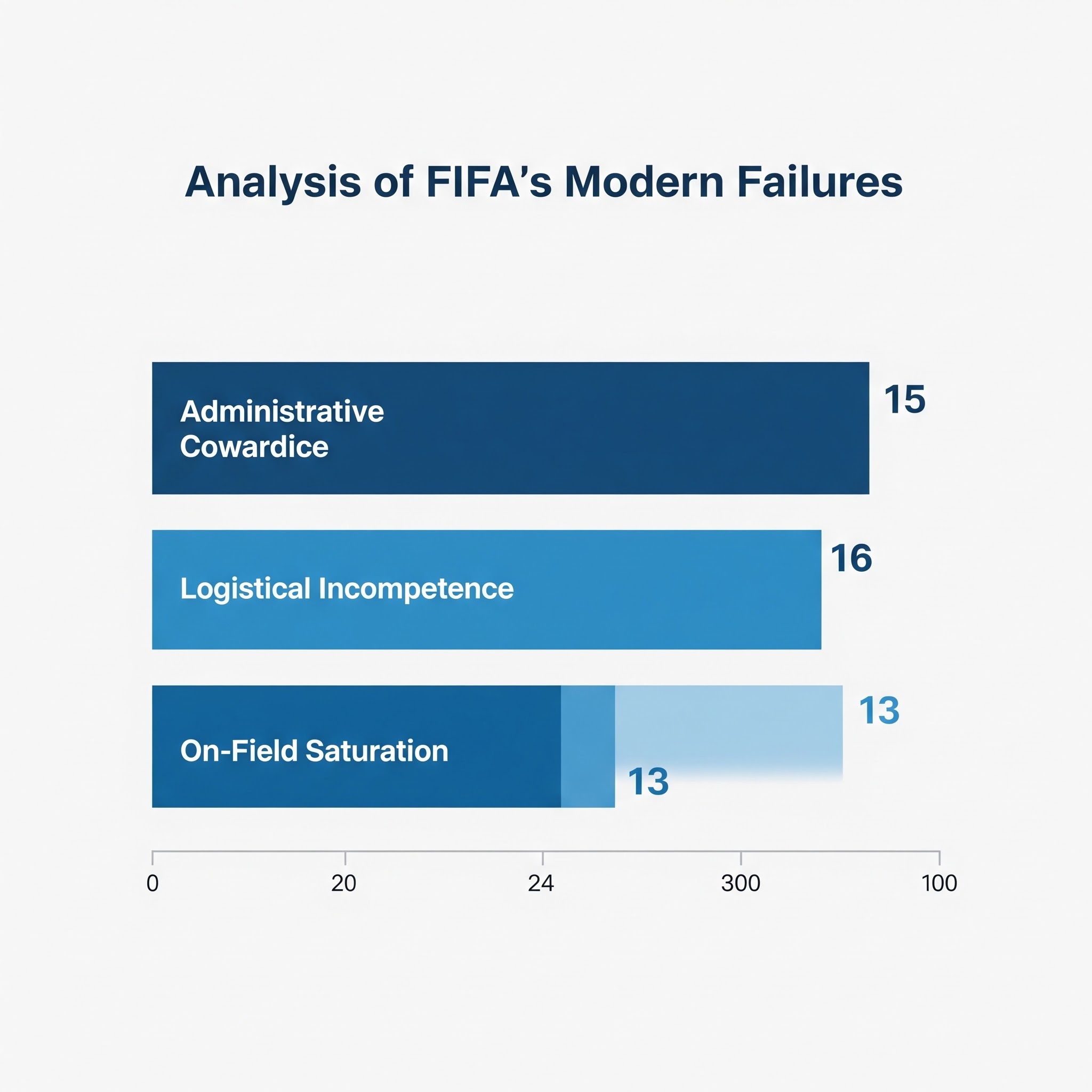
What followed from FIFA was a clinic in bureaucratic cowardice. Rather than defending its own highly vetted official or standing firm on the principle that football should remain free from political interference, FIFA completely abandoned Artan. In a sterile public statement, a FIFA spokesperson effectively washed their hands of the situation:
"FIFA is not involved in host country immigration processes... a host government ultimately determines who receives a visa and who is admitted into their country."
Following this shrug of the shoulders, FIFA promptly and ruthlessly cut Artan from the tournament's official referee list.
A Failure of Imagination and Flexibility
The true disgrace of the Artan affair lies in FIFA's complete refusal to exercise administrative flexibility. This is not a single-host tournament; the World Cup is being jointly hosted by the United States, Mexico, and Canada. If the political climate in Washington presented an insurmountable barrier for an elite African official, a competent governing body would have immediately adapted.
FIFA should have allowed for a swift rescheduling of Artan's involvement, shifting his match assignments to host cities in countries that were entirely open to letting him in. Canada being one.
Cities like Toronto and Vancouver possess the world-class infrastructure and inclusive entry policies necessary to accommodate an elite international official without subjecting them to political profiling. By failing to reallocate Artan’s matches to Canadian soil, FIFA chose the path of least resistance, allowing political posturing to dictate who can and cannot participate in the world's game. It sent a chilling message to smaller, developing nations: your sporting merit is entirely secondary to the border policies of the superpower hosting the event.
A Broader Crisis: On-Field and Off-Field Decay
The mishandling of Omar Artan is not an isolated incident; it is a symptom of a wider systemic failure currently rotting the core of FIFA's executive branch.
1. Logistics and Fan Experience
Off the field, the 2026 expansion has exposed massive logistical oversight. Fans, journalists, and team staff members from dozens of nations have faced severe visa delays and arbitrary denials. Members of the Iranian national team's staff were denied entry entirely, forcing the squad to relocate their training base to Mexico. Ticket prices have soared to astronomical levels, local transport infrastructure in several host cities is vastly underprepared for the multi-city travel demands, and the soul of the tournament is being commodified at the expense of ordinary match-going supporters.
2. Sporting Integrity and Competition Dilution
On the field, the expansion to 48 teams has diluted the competitive edge of the group stages, threatening to turn what used to be a elite, high-stakes tournament into a bloated marathon. Compounding this is the persistent, inconsistent implementation of technology. While VAR and semi-automated offside systems were promised to bring objective clarity, arbitrary rule interpretations and a lack of unified training across different confederations have left players, managers, and fans completely alienated by the decision-making process.
The Manifestation of FIFA's Modern Failures
The Path Forward: A Needed Awakening
Despite the dark cloud currently hanging over the executive suites in Zurich, the global football community must look toward the future with a sense of defiant optimism. The sport does not belong to the bureaucrats who draft the press releases; it belongs to the players, the fans, and the dedicated match officials who uphold the spirit of fair play on the pitch.
There is still hope that some of these critical issues can be handled and resolved by FIFA and its managers in the coming cycles. For that to happen, the governing body requires a massive cultural reset. FIFA must transition away from acting as a purely commercial corporate entity and return to its fundamental mandate: protecting the global game.
Future tournament bidding processes must include binding, ironclad guarantees from host nations regarding the unhindered entry of all qualified participants, regardless of their passport. Furthermore, internal management must cultivate the operational agility demonstrated by other global sporting bodies, ensuring that alternative hosting options—like Canada—are utilized as active solutions rather than ignored fallbacks.
Omar Artan returned home to Mogadishu to a hero’s welcome, displaying a level of grace, positivity, and class that stands in stark contrast to the organization that failed him. If FIFA's managers want to restore the tarnished credibility of international football, they would do well to match the integrity of the referee they left behind.