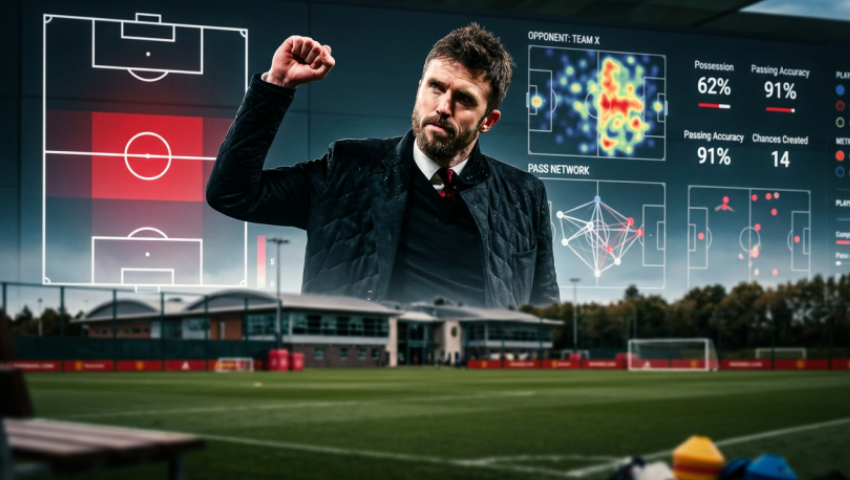
For the better part of a decade, the narrative emerging from Old Trafford during the summer months followed a tragically predictable script. It was a chaotic theater of panic buys, public boardroom scuffles, and inflated valuations—a reactive scramble that routinely left incoming managers trying to build a puzzle with mismatched pieces.
But as the curtains rise on the preparation for the 2026/27 campaign, a profound, almost unfamiliar silence has settled over Carrington. It is not the silence of apathy, but the quiet, deliberate hum of an elite football structure operating with clinical, proactive precision.
With Michael Carrick newly confirmed on a permanent contract until 2028, Manchester United's executive leadership group—orchestrated by Chief Executive Omar Berrada and Director of Football Jason Wilcox—has fundamentally flipped the script. Recognizing that their tactically brilliant but relatively inexperienced head coach requires a bespoke environment to thrive, the club has initiated a pragmatic, lightning-fast summer recruitment strategy designed to seal crucial deals long before the pre-season whistle blows.
The January Epiphany and the Carrick Catalyst
To understand the genius of United’s current recruitment strategy, one must examine the catalyst of this new era. When Carrick stepped into the dugout in January 2026 as an interim replacement following Ruben Amorim's turbulent tenure, the club was fractured, sitting sixth in the table and dumped out of cup competitions.
What followed was nothing short of a tactical masterclass. The 44-year-old former midfield maestro didn't just steady the ship; he overhauled its mechanics. Re-establishing the club’s traditional values of fluid, possession-based football and fearless youth integration, Carrick guided United through a sensational 16-game run. Securing 11 victories—including seismic, statement wins over Manchester City, Arsenal, Liverpool, and Chelsea—Carrick achieved the highest points tally in the Premier League from the moment of his arrival, ultimately steering the club to a comfortable third-place finish and a guaranteed return to the UEFA Champions League.
The dressing room's response was visceral. Young core players like Kobbie Mainoo, who flourished after being restored to the heart of the midfield, openly declared their fierce loyalty to Carrick's vision. Captain Bruno Fernandes rediscovered the finest form of his career, equalling the Premier League assist record and claiming the Football Writers' Player of the Year award.
Yet, despite the euphoria of returning to Europe’s elite, the United hierarchy remained clear-eyed. Carrick possesses an extraordinary tactical mind and an innate understanding of the club’s DNA, but his top-flight managerial resume is brief. To expect him to mount a serious title challenge across a grueling, congested multi-competition schedule without immediate, tailored reinforcements would be a dereliction of duty.
Pragmatism Over Hype: Shifting the Transfer Paradigm
Historically, United chased the marquee names available on the market, regardless of tactical fit. The 2026 summer strategy represents a total rejection of that philosophy. Led by Wilcox's data-driven, profile-first scouting model, United’s recruitment has become remarkably proactive.
Instead of waiting for the market to dictate terms, the club identified structural weaknesses in April and moved aggressively to execute deals the moment the window creaked open. The ultimate goal? To provide Carrick with a complete, integrated squad by the first day of pre-season training, sparing him the disruption of late-August panic arrivals.
Manchester United: The Changing Transfer Philosophy
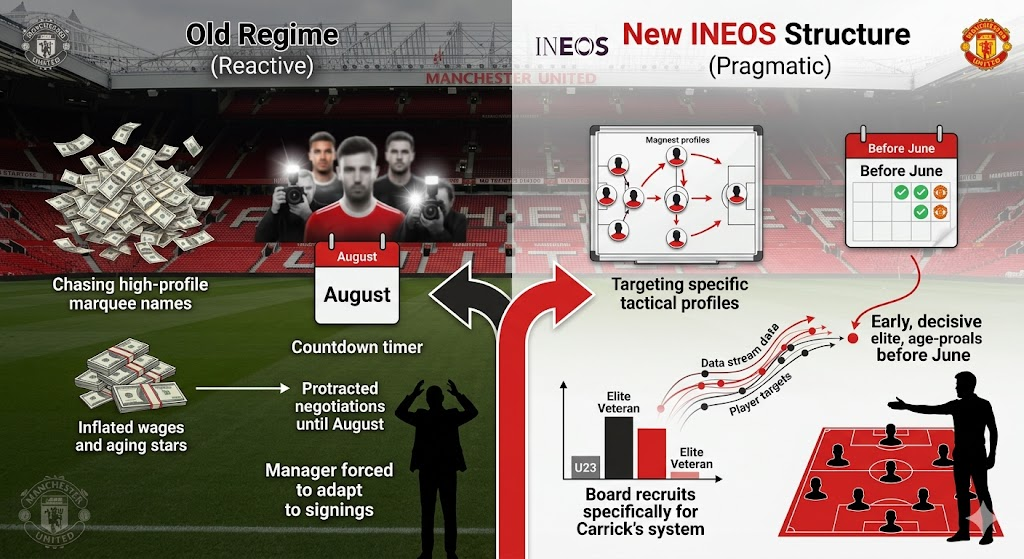
The primary focus of this pragmatic overhaul sits squarely at the base of the midfield. While Casemiro’s legendary career provided a shield in seasons past, the relentless physical demands of Carrick's high-pressing, transitional style require a passing anchor that mirrors the manager's own playing days: technically immaculate, positionally disciplined, and highly press-resistant.
By identifying and wrapping up the signatures of an elite, young deep-lying playmaker and a physically imposing progressive center-back early, United has eliminated the "adaptation tax" that usually derails their autumn campaigns. Carrick will not have to spend September teaching new signings where to stand; he will spend July drilling them into a cohesive unit.
Creating an Environment for Success
Securing elite profiles early is only half the battle. For a young manager, the internal infrastructure is just as vital as the playing squad. Berrada and Wilcox have systematically insulated Carrick from the media storms and political crosswinds that consumed previous managers like José Mourinho and Erik ten Hag.
By establishing a rigid, world-class sporting department, United has drawn a clear line in the sand:
The Board is responsible for the long-term squad value, contract renewals, and scouting pipelines.
Michael Carrick is responsible for elite coaching, tactical execution, and player development.
"Michael has thoroughly earned the opportunity," Jason Wilcox noted upon Carrick's permanent appointment. "In the time he has been doing the role, we have seen an approach which aligns with the club's values, traditions, and history... we are continuing to build a winning culture at Carrington."
This alignment means Carrick does not have to waste cognitive energy acting as a chief scout or a corporate spokesperson. He can focus entirely on what he does best: crafting meticulous tactical structures on the grass, refining the half-spaces for Bruno Fernandes, and nurturing the generational talents of Mainoo and Amad Diallo.
Furthermore, the club's pragmatism is reflected in their squad-cleansing. Deadwood and high-earning squad players who do not fit Carrick’s high-tempo possession model are being systematically moved on. This creates a tight-knit, hungry, and mathematically optimized roster where every player understands their exact role within the tactical ecosystem.
The Unforgiving Road Ahead
The upcoming 2026/27 campaign will offer no hiding places. The Champions League's expanded format promises a grueling calendar, and the domestic competition at the summit of the Premier League has never been more ruthless.
However, by marrying Carrick’s calm, authoritative locker-room presence with a hyper-efficient, proactive recruitment drive, Manchester United has finally given themselves a structural advantage. They are no longer entering a knife fight with a blueprint they began drafting five minutes before kickoff.
The deals are being finalized, the targets are locked in, and the environment is meticulously prepared. For Michael Carrick, the stage is set. For the rest of Europe, the warning signs are clear: Manchester United is finally operating like an elite football club again.