For the better part of the last three years, the mention of BlueCo in elite footballing circles elicited a collective, cynical eye-roll. To the global football community, they were the ultimate personification of Silicon Valley hubris transplanted into a sport that stubbornly refuses to be mastered by a spreadsheet. To the Stamford Bridge faithful, they were an ownership group that felt entirely tone-deaf—an algorithmic regime that viewed their beloved institution not as a cathedral of passion, but as a laboratory for amortized contracts, multi-club synergy, and "Project 2033" assets.
Then came the chaotic, dizzying freefall. Six defeats on the bounce. The tactical turmoil under Liam Rosenior that ended in an inevitable, unceremonious parting of ways. A dressing room in a state of existential coma, and a fanbase entirely alienated by a revolving door of "Head Coaches" who felt less like leaders and more like corporate middle managers executing a directive from above.
But football has an incredible way of forcing humility upon the proudest of billionaires.
With the spectacular appointment of Xabi Alonso, BlueCo hasn't just hired a manager; they have executed a profound, necessary, and monumental pivot. For the first time since they walked through the doors of Stamford Bridge, the hierarchy has stopped trying to outsmart the game. They have listened to the terrace roars, absorbed the scathing critiques of the global media, and accepted a fundamental truth: Chelsea Football Club cannot be governed by an algorithm. It needs an emperor.
Moving Past the "Head Coach" Delusion
To truly appreciate why Alonso's appointment is a watershed moment for GoalPoles readers, one must look closely at the specific vocabulary deployed in the announcement. Alonso is not arriving as a "Head Coach"—the sterile, restricted title handed to his predecessors. He is arriving as the Manager.
Under the previous sporting structure, the BlueCo model demanded a subservient tactician. The sporting directors bought the raw, unpolished diamonds from Strasbourg to South America, and the coach was simply expected to arrange them on the pitch. It was a corporate separation of church and state that stripped the dressing room of authority. When the tactical turmoil hit, the coach had no structural power to fix it, and the players knew it.
By restoring the traditional, far-reaching title of Manager to Xabi Alonso, BlueCo has finally conceded that the modern elite footballer requires a singular, towering figurehead.
Alonso is a man who commands immediate, breathless respect. You cannot look at a World Cup winner, a two-time European Champion, and the mastermind behind Bayer Leverkusen's historic, undefeated domestic double, and tell him which 20-year-old he is forced to develop. By granting him managerial autonomy, BlueCo is signaling to the football world that their rigid, top-down recruitment dogmatism is flexible. They are acknowledging that a world-class sporting project requires a football man at the wheel, not a committee in a boardroom.
A Healing Balm for an Identity Crisis
Chelsea’s recent history has been defined by a crippling identity crisis. Fans watched a squad assembled with astronomical wealth look entirely devoid of soul, fighting a losing battle just to stay relevant in the Premier League. The Stamford Bridge crowd is a demanding electorate; they are nurtured on the memories of José Mourinho's pragmatism, Carlo Ancelotti’s swagger, and Thomas Tuchel’s tactical steel. They know what elite management looks and feels like.
Alonso represents the absolute gold standard of the modern managerial elite. He is the logical cure for a club that had forgotten who it was.
THE ALONSO EFFECT: REBALANCING BLUECO
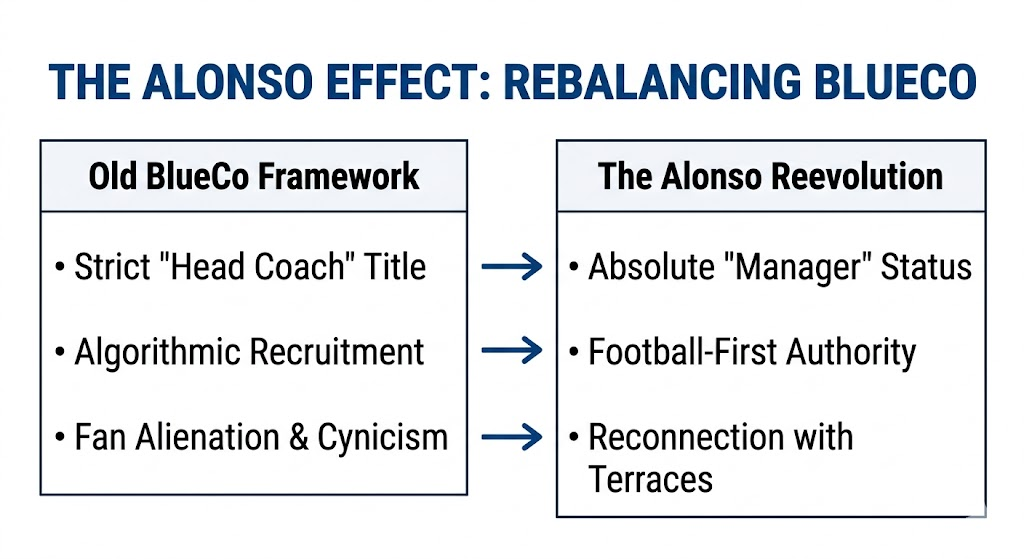
When Alonso walks out of the tunnel, the atmosphere changes. He brings a serene, unflappable gravity that instantly stabilizes a club in chaos. Where previous regimes prioritized youth purely for future balance sheets, Alonso’s track record proves he develops talent to win trophies. He doesn't just collect pieces; he crafts a collective. For a fanbase that felt entirely ignored, this appointment is validation. It is an admission by ownership that the fans' demands for elite standards, tactical clarity, and institutional pride were entirely correct all along.
The Ultimate Statement to the Football World
Beyond the boundaries of Southwest London, this appointment has sent shockwaves through Europe. For months, the narrative surrounding BlueCo was one of regression. Rival executives watched the Bernabéu implosion, the struggles of the multi-club network, and Chelsea’s mathematical elimination from Champions League contention with a sense of predatory satisfaction. The project was viewed as a cautionary tale of American sports ownership failing to grasp the promotion-and-relegation, high-stakes terror of European football.
Snatching Xabi Alonso—a man coveted by every super-club on the planet—changes the global paradigm overnight.
It proves that despite the missteps, the financial might and foundational appeal of Chelsea remain an undeniable draw when backed by a realistic sporting vision. Alonso would not have jeopardized his pristine, skyrocketing managerial reputation if he hadn't been promised genuine control. By agreeing to his terms, BlueCo has salvaged their own credibility. They have shown the football world that they possess the financial muscle to correct their course and the humility to adapt when their original thesis is proven flawed.
The Hard Work Begins Now
Let there be no illusions: Alonso is walking into a sporting landscape littered with pressure. He inherits a squad that has suffered immense psychological bruising. He must navigate the complex, long-term financial commitments of the "2033 Project" while immediately delivering the top-tier results that a club of this magnitude demands.
Yet, for the first time in years, there is a profound sense of harmony sweeping through the club.
By listening to the football world, by bending their rigid structure to accommodate a generational managerial talent, BlueCo has done something far more valuable than simply signing a world-class tactician. They have bought back the trust of their own people. The era of the corporate, algorithmic experiment is over. The era of the football manager has returned to Stamford Bridge, and it arrives in the elegant, commanding shape of Xabi Alonso.