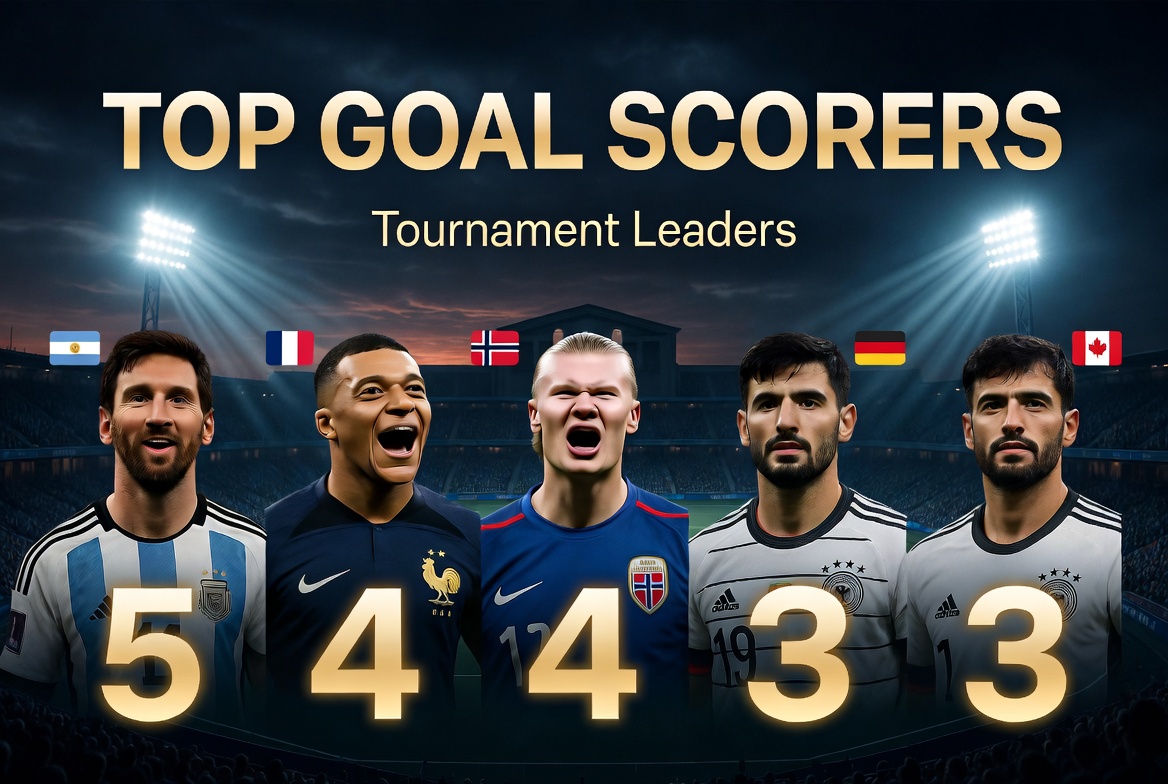
The Master and the Golden Boot Frontrunners
The opening block of fixtures has established a clear hierarchy at the summit of the goalscoring charts. Three distinct icons are driving their respective nations forward, setting a historic pace.
Lionel Messi (Argentina) – 5 Goals
Just when the world thought Lionel Messi had completed his script in Qatar, the 38-year-old maestro continues to defy father time. In just two group stage fixtures, Messi has converted five goals, a returns sequence featuring a majestic opening-day hat-trick against Algeria and a clinical brace to dismantle Austria 2-0.
By hitting his 18th career World Cup goal, Messi officially surpassed Miroslav Klose to become the outright all-time leading goalscorer in tournament history. While he did secure an unwanted record by registering his third career non-shootout penalty miss early against the Austrians, his immediate response—a precise, first-time stroke into the bottom corner—underlines an unshakeable psychological state. Messi is operating as a hybrid trequartista, conserving energy and materializing in the final third with lethal efficiency.
Kylian Mbappé (France) – 4 Goals
If Messi represents the twilight of an era, Kylian Mbappé is the roaring noon. France’s captain has entered his prime at 27 years old, terrorizing defensive lines with his signature explosive shifts of gear. Carrying four goals into the knockout conversation, Mbappé's latest masterclass against Iraq cemented France's smooth entry into the Round of 32.
With 14 career World Cup goals to his name, Mbappé is chasing Messi's freshly minted record at an alarming trajectory. Didier Deschamps has structured Les Bleus to maximize the forward's isolation scenarios on the left flank, meaning his output is highly sustainable as the tournament intensifies.
Erling Haaland (Norway) – 4 Goals
Norway’s presence at this expanded World Cup was highly anticipated, solely to see how Erling Haaland would translate his domestic dominance onto the international stage. The Manchester City center-forward has not disappointed.
Haaland has bulldozed his way to four goals, spearheading a thrilling 3-2 victory over Senegal that locked Norway into the knockout phases. Operating as a pure, hyper-athletic number nine, Haaland requires far fewer touches than Messi or Mbappé to alter a scoreline. His presence transforms Norway into a volatile wild card capable of wounding any elite backline.
The Statistical Landscape
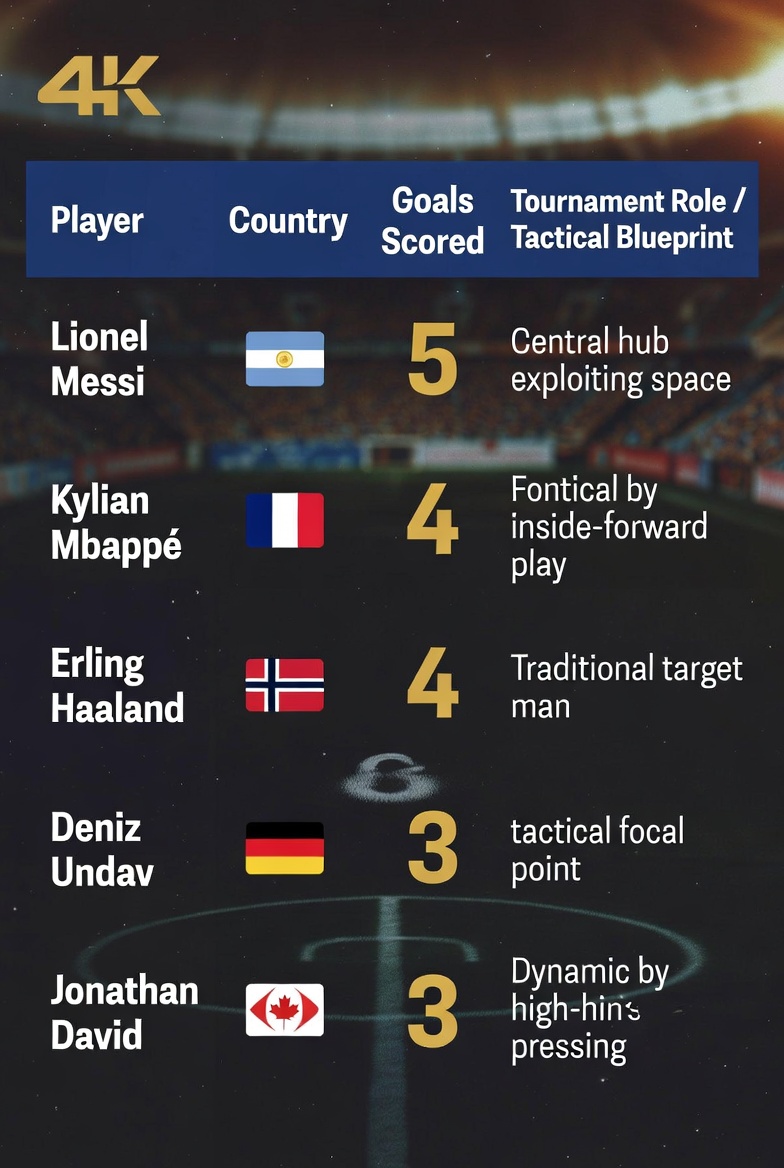
To contextualize the golden boot hunt, the current top-tier efficiency looks as follows:
The Outsiders and Tactical Catalysts
Behind the leading trio sits a hungry tier of forwards capable of altering the tournament's trajectory.
Germany’s Deniz Undav (3 goals) has been the unexpected spark plugs for a high-flying Nationalelf. Under a structured system, Undav has displayed brilliant positional intelligence, converting chances generated by a creative midfield engine. With Germany racking up 9 goals in their opening two games, Undav's numbers could inflate rapidly if they sustain their offensive rhythm.
Concurrently, Jonathan David (3 goals) has galvanized co-hosts Canada. Backed by raucous home crowds, David’s mobility and clinical edge have given the Canadians an elite offensive dimension, making them a dangerous outfit to draw in the single-elimination brackets.
We also cannot dismiss elite figures like England's Harry Kane or Brazil's Vinícius Júnior, both sitting on two goals. While they haven't matched the explosive starts of Messi or Mbappé, their team structures guarantee deep tournament runs, offering plenty of runway to close the gap.
Tournament Projections: Who Lifts the Trophy?
To predict the ultimate winner of the 2026 World Cup, one must balance individual goalscoring prowess with defensive structural integrity. History dictates that while transcendent individual stars win Golden Boots, complete, balanced tactical structures win world championships.
1. France: The Pragmatic Favorites
Despite Messi's romantic narrative, France remains the most logical projection to win the tournament. Under Deschamps, the French squad possesses unmatched squad depth and tournament scar tissue.
With Mbappé firing at maximum capacity, flanked by elite creators, France doesn't need to dominate 90 minutes of possession to control a football match. Their defensive solidity, combined with their devastating transitional speed, makes them the most complete unit in North America.
2. Argentina: The Emotional Juggernaut
Lionel Scaloni’s men are operating under a familiar, potent psychological spell: the collective desire to protect and elevate Lionel Messi. Argentina has yet to concede a goal in the group stages, proving that their defensive foundation remains as resolute as it was in Doha.
If Messi maintains this historic efficiency, Argentina can grind out victories against anyone. However, their reliance on a 38-year-old to unlock elite low-blocks remains a marginal risk in comparison to France's multifaceted avenues of attack.
3. Germany: The Dark Horse Modern Machine
Boasting the highest goal-differential (+7) after two matchdays, the Germans have blended youthful exuberance with clinical execution. If their defensive transition holds up against elite counter-attacking sides, their collective goalscoring approach makes them a legitimate threat to go all the way.
The Goalpoles Verdict
We are witnessing a truly vintage World Cup. While Erling Haaland will break individual boundaries for Norwegian football and Lionel Messi will continue to rewrite the sport's history books, the ultimate prize requires structural perfection.
Because of their unparalleled tactical depth, tournament experience, and the lethal form of Kylian Mbappé, France is the most equipped side to navigate the grueling knockout brackets and claim the 2026 World Cup title.
Which heavy hitter do you believe will make the difference when the bracket phase begins? Let us know your thoughts in the comments section below!